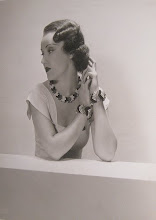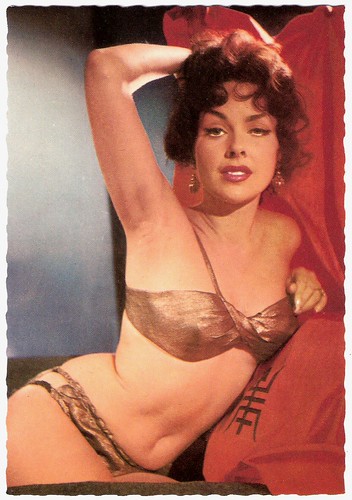
British-Austrian actress Mara Lane (1930) was considered one of the most beautiful models in Great Britain during the early 1950’s. She appeared in more than 30 English and German language films of the 1950’s and early 1960’s, but seems completely forgotten now.

Dany Saval
Dany Saval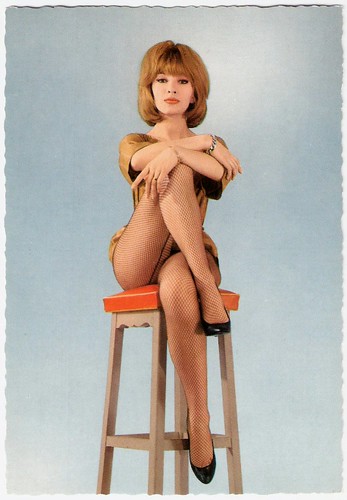
Gorgeous French actress Dany Saval (1942) was the lithe and lovely leading lady in both fluffy comedies and thrillers of the late 1950’s and early 1960’s.
Dany Saval was born as Danielle Nadine Suzanne Savalle in 1942 in in a slum area of Paris, France. The Germans had just before released her father, a factory worker, from a prisoner-of-war camp. Dany started her career at 8, as a child-dancer. Later she became a Can-Can girl at the Moulin Rouge. Her first film appearance was a small part in L'eau vive/The Girl and the River (1958, François Villiers) starring Pascale Audret. The film, based on a screenplay by pacifist writer Jean Giono, won a Golden Globe as Best Foreign-Language Film in 1959. She then appeared in the French answer to Rebel Without A Cause, Les Tricheurs/The Cheaters (1958, Marcel Carné), as the fiancée of Pierre Brice. Les Tricheurs tells the story of disaffected Parisian youth who have lost their way in an atmosphere of existentialism, sexual liberation and disrespect for traditional and religious values. On the huge success of Les Tricheurs followed bigger roles in such films as Asphalte/Asphalt (1959, Hervé Bromberger) with Francoise Arnoul, La verte moisson/Green Harvest (1959, François Villiers) and the supernatural thriller Pleins feux sur l'assassin/Spotlight on a Murderer (1961, Georges Franju) starring Pierre Brasseur.
Suddenly one of Disney’s talent scouts saw Dany Saval on a magazine cover and after a screentest Walt Disney signed her to a six-film contract. In her first film, Moon Pilot (1962, James Neilson), she played a mysterious extraterrestrial opposite astronaut Tom Tryon. Hal Erickson of All Movie Guide likes the film: “Moon Pilot is an engaging Disney sci-fi comedy that manages to shoot off a few neat and surprisingly satirical barbs at the hypertense US/Russia ‘space race’ of the era.” On IMDB, reviewer San Diego comments: “Watch it for Dany Saval... (she) makes the film worth watching.” Despite these positive reviews, the film bombed and Dany Saval would make only one more American film. Today she is probably best known as one of the lovely airline stewardesses being shuffled around by Tony Curtis and Jerry Lewis in the slapstick comedy Boeing Boeing (1965, John Rich). IMDB reviewer Moonspinner55 writes: “Perky Dany Saval (as ‘Air France’) is the stand-out amongst the lovely ladies, none of whom gets an actual character to play.” In between she appeared in several fluffy French comedies opposite such comedians as Louis de Funès and Darry Cowl. She also appeared opposite Michele Morgan in the crime thriller Constance Aux Enfers/Web of Fear (1964, François Villiers). In 1965 she married distinguished composer Maurice Jarre, with whom she had a daughter, Stéfanie Jarre. She then retired temporarily from the screen to raise her child.
In 1970, Dany Saval made a come-back on TV in the popular comedy series Les saintes chéries/The Sweet Saints starring Micheline Presle. More TV work and films followed. She was the leading lady in the spaghetti western Si può fare... amigo/Saddle Tramps (1972, Maurizio Lucidi) starring Bud Spencer and Jack Palance. In the popular action comedy L’Animal/The Animal (1977, Claude Zidi), she appeared opposite Jean-Paul Belmondo and Raquel Welch. And she played a supporting part in the detective comedy Inspecteur la Bavure/Inspector Blunder (1980, Claude Zidi) starring Coluche and Gérard Dépardieu. Her last (TV) film was La baleine blanche/Children and the White Whale (1987, Jean Kerchbron). Then, Dany Saval retired from the film and entertainment business. She married three times. Her first marriage was with pr-man Roger Chaland in 1958. Her second marriage with Maurice Jarre ended in a divorce in 1967. Since 1973, she is married to host and journalist Michel Drucker, with whom she resides in Paris.
Sources: Lloyd Shearer (The Modesto Bee), Hal Erickson (All Movie Guide), Wikipedia, and IMDb.

Lil Dagover was actress whose career spanned nearly six decades
Lil Dagover
Gallery for vintage actress Lil Dagover
Dolly Haas was popular in the 1930s as a vivacious red haired gamine
Dolly Haas
Stage and screen actress Dolly Haas (1910-1994) was popular in the 1930’s as a vivacious, red-haired gamine often wearing trousers in German and British films.
Gallery for vintage actress Dolly Haas
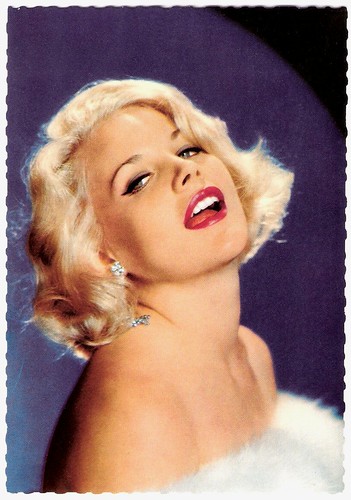
Annabella
Annabella
French film star Annabella (1909-1996) was France's most popular actress during the mid 1930’s, but she also achieved some success in Hollywood films of the late 1930’s.
Simone Simon
Simone Simon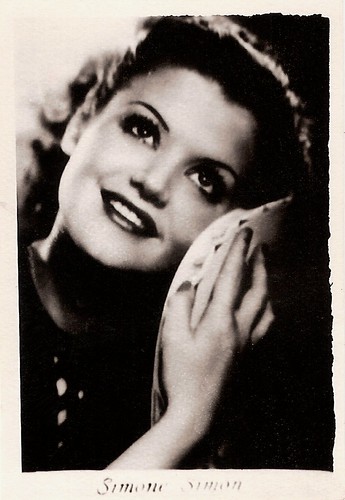
Kittenish French actress Simone Simon (1910-2005) was one of the most seductive and brilliant stars of the French cinema of the 1930’s and 1950’s. Publicity dubbed her ‘La Sauvage Tendre’ (The Tender Savage).
Charles de Rochefort
Charles de Rochefort
Charles d’Authier de Rochefort (1887-1952) was born in Port-Vendres, France. In 1910 he started to play in film, most of all in the Pathé comedies of Max Linder (8 films between 1910 and 1914), but also in Pathé dramas by Georges Denola, Albert Capellani and Abel Gance. In 1918 he performed in the serial Impéria (12 episodes) by Jacques Durand, with Jacqueline Forzane. After the films Marthe (Gaston Roudès 1919), Fille du peuple (Camille de Morlhon 1920), L’empire du diamant (Léonce Perret 1920) and Roi de Camargue (André Hugon 1921) – for which film this postcard might have been – De Rochefort again appeared in two serial films: Gigolette (Henri Pouctal 1921, 4 episodes) and L’empereur des pauvres (René Leprince 1921, 6 episodes). In 1922 Rochefort played in several films: in Antoine’s L’Arlésienne, two films by Hugon: Notre dame d’amour and Le diamant noir, L’homme qui pleure by Louis d’Hée, and the co-production The Spanish Jade/Sous le soleil d’Espagne by John S. Robertson and starring Evelyn Brent. After two more French films in 1923: La dame au ruban de velours (Giuseppe Guarino) with Arlette Marchal, and La faute des autres (Jacques Olivier) with Mary Thay, Charles de Rochefort went to Hollywood.
There, in 1923, he played in The Marriage Maker by William C. DeMille, with Mary Astor; he briefly appeared in Holywood/Joligud by James Cruze; he also played in The Cheat by George Fitzmaurice, with Pola Negri; The Law of the Lawless by Victor Fleming, with Dorothy Dalton; and The Ten Commandments by Cecil B. DeMille, with Rod La Rocque. In the subsequent year 1924 followed 4 more American films: Love and Glory by Rupert Julian; Shadows of Paris by Herbrt Brenon; The White Moth by Maurice Tourneur; and Madame Sans-Gêne by Léonce Perret, a super-production around Gloria Swanson. In 1925 Roochefort left Hollywood and returned to France, where he played in one film: La princesse aux clowns (Hugon) with Huguette Duflos. Rochefort then stayed away from film for four years. When he returned in 1929 it was not as actor but as director at the Parisian Paramount sound studios, first with Une femme a menti (1929) with Louise Lagrange and scripted by Henri Koster [Hermann Kosterlitz], then in 1930 with the French, Italian, Czech and Rumanian version of Paramount on Parade, starring resp. Maurice Chevalier, Carmen Boni, Jiri Voskovec and Pola Illéry. Rochefort also directed the mulitilingual Le secret du docteur (1930), with Marcelle Chantal in the French and Eugenia Zoffoli in the Spanish version. In 1931 Rochefort acted once more in the film La croix du sud (Hugon), for which he also did the photography, and he directed Televisione, the Italian version of the Paramount multilingual Television. He also directed the short Dorville chauffeur (1930) and Un bouquet de flirts (1931) with Josette Day. Charles de Rochefort died in Paris in 1952.
Adam Faith
Adam Faith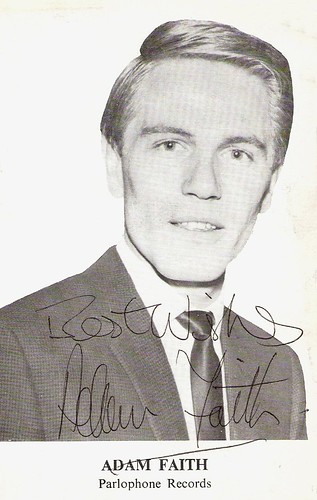
British fan card by The Adam Faith Fan Club, London. Photo: Parlophone Records.
English pop singer, actor and financial journalist Adam Faith (1940-2003) started as one of the more popular British teen idols, turned into a top actor and then became a financier. In the early 1960’s he was the first British artist with his initial seven hits lodging in the Top 5, just before the Beatles came along and changed the entire musical landscape.
Adam Faith was born as Terence (Terry) Nelhams-Wright in London in 1940. The third in a family of five children, Nelhams grew up in a council house in a working class area of London. He started work at 12, delivering and selling newspapers while still at school. Faith began his musical career in 1957, while working as a film cutter in London in the hope of becoming an actor, singing with and managing a skiffle group, The Worried Men. The group played in Soho coffee bars after work, and became the resident band at The 2i's Coffee Bar, where they appeared on the BBC Television live music program Six-Five Special. The producer, Jack Good, was impressed by the singer and arranged a solo recording contract with HMV under the name Adam Faith. His debut record (Got a) Heartsick Feeling and Brother Heartache and Sister Tears in January 1958, failed to make the charts. His second release later that year was a cover of Jerry Lee Lewis' High School Confidential, but this also failed. Faith returned to work as a film cutter at National Studios at Elstree until March 1959, when Barry invited him to audition for a BBC TV rock and roll show, Drumbeat. The producer, Stewart Morris, gave him a contract for three shows, extended to the full 22-week run. Faith was becoming popular through television appearances. Faith's success on Drumbeat enabled another recording contract with EMI's Parlophone label. His next record in 1959, What Do You Want?, written by Vandyke and produced by Barry and John Burgess, received good reviews in the NME and other music papers, as well as being voted a hit on Juke Box Jury. It soared to number one on the British charts in the course of a 19-week run. His pronunciation of the word 'baby' as 'bay-beh' became a catch phrase.
Adam Faith became an immediate star, with his matinee-idol looks and charismatic screen presence. At the time, he was distinctive for his hiccupping glottal stops and exaggerated pronunciation. He did not write his own material, and much of his early success was through partnership with songwriter Les Vandyke and John Barry, whose arrangements were inspired by Don Costa's pizzicato arrangements for Buddy Holly's It Doesn't Matter Anymore. With songs such as Poor Me (another UK chart topper), Someone Else's Baby (a UK #2) and Don't That Beat All, he established himself as a rival to Cliff Richard in British popular music. Poor Me also later became the title of his first autobiography. He became an actor by taking drama and elocution lessons, and appeared as a pop singer in the film Beat Girl (1959, Edmond T. Gréville), according to Bruce Eder on All Music “a fairly gritty British delinquency drama”. His next film Never Let Go (1960, John Guillermin) starred Peter Sellers and Richard Todd. A UK variety tour was followed by a 12-week season at Blackpool Hippodrome and an appearance on the Royal Variety Show. His next release was a double A-side single, Made You/When Johnny Comes Marching Home. Both made the Top Ten, despite a BBC ban for Made You for 'a lewd and salacious lyric'. His 1960 novelty record Lonely Pup (In a Christmas Shop), to coincide with his Christmas pantomime, gained a silver disc. His debut album Adam was released on in 1960 to critical acclaim for the inventiveness of Barry's arrangements and Faith's own performances. Still 20 and living with his parents, he bought a house in Hampton Court for £6000, where he moved with his family from their house in Acton. In January 1961, NME reported that Faith had been booked to headline the television show, Sunday Night at the London Palladium. Faith's third film, the comedy What a Whopper (1961, Gilbert Gunn) with Sid James and Carole Lesley, opened to a terrible pasting from the press. On IMDb reviewer Peter Yates writes: “Almost makes Plan 9 seem workable”. Faith’ next film project, Mix Me a Person (1962, Leslie Norman) starring Anne Baxter, received good reviews. This was a thriller in which his character (Harry Jukes) spent a great deal of time behind bars. He did manage to sing a couple of songs, however, en route; the title song and a version of La Bamba.
Adam Faith's teen pop became less popular in the mid 1960’s with competition from The Beatles. In 1965 he made his only two appearances in the US Billboard Hot 100 chart with It's Alright (#31) and Talk About Love (#97). He made six further albums and 35 singles, with a total of 24 UK chart entries. After a final single in 1968 he parted company with EMI and concentrated on acting in repertory theatre. After a number of small parts, he was given a more substantial role in Night Must Fall, playing opposite Dame Sybil Thorndike. In autumn 1969 he took the lead in a touring production of Billy Liar. Faith began 1970 by appearing on the BBC's review of the sixties music scene, Pop Go The Sixties, performing What Do You Want and Someone Else's Baby live on the show's broadcast on BBC1, on 1 January 1970. Later in the 1970’s, he went into music management, managing Leo Sayer among others. Faith also co-produced Sayer's 1975 album, Another Year, and earlier had co-produced Roger Daltrey's album, Daltrey (1973). He starred as the eponymous hero in the television series Budgie (1971-1972), about an ex-convict, but his career declined after a car accident in which he almost lost a leg. He restarted with a role as the manipulative manager of rock star David Essex, in Stardust (1974, Michael Apted). He was nominated for a BAFTA award for Best Actor in a Supporting Role. In 1980 he starred with Roger Daltrey in McVicar (1980, Tom Clegg), and appeared with Jodie Foster in Foxes (1980, Adrian Lyne). He played the role of James Crane in the TV film Minder on the Orient Express (1985). Faith appeared in another TV series, Love Hurts (1992-1994) starring with Zoë Wanamaker, the BBC series, The House That Jack Built (2002, Nick Philips) and an episode of Murder in Mind (2003). In the 1980’s, Faith became a financial investments advisor, but he still continued to perform. In 1986, he was hired as a financial journalist, by the Daily Mail and its sister paper, The Mail on Sunday. He had a financial involvement with television's Money Channel, but the channel proved unsuccessful and closed in 2001. Faith was declared bankrupt owing a reported £32 million. In 1985, he appeared on a BBC Radio 2 tribute program to James Dean, written and presented by Terence Pettigrew. You're Tearing Me Apart was aired on the 30th anniversary of Dean's death. Dean had been his idol, and the film Rebel Without A Cause had inspired the teenage Faith to become a singer and actor. Faith had had heart problems since 1986, when he had open heart surgery. He became ill after his stage performance in the touring production of Love and Marriage at the Regent Theatre, and died in a hospital in Stoke-on-Trent of a heart attack in 2003. Since 1967, Adam Faith was married to former dancer Jackie Irving and they had one daughter Katya Faith, a television producer.
Sources: Bruce Eder (All Music Guide), Geoff Leonard and Pete Walker (IMDb), Wikipedia and IMDb.
Subscribe to:
Posts (Atom)


 Posts
Posts